


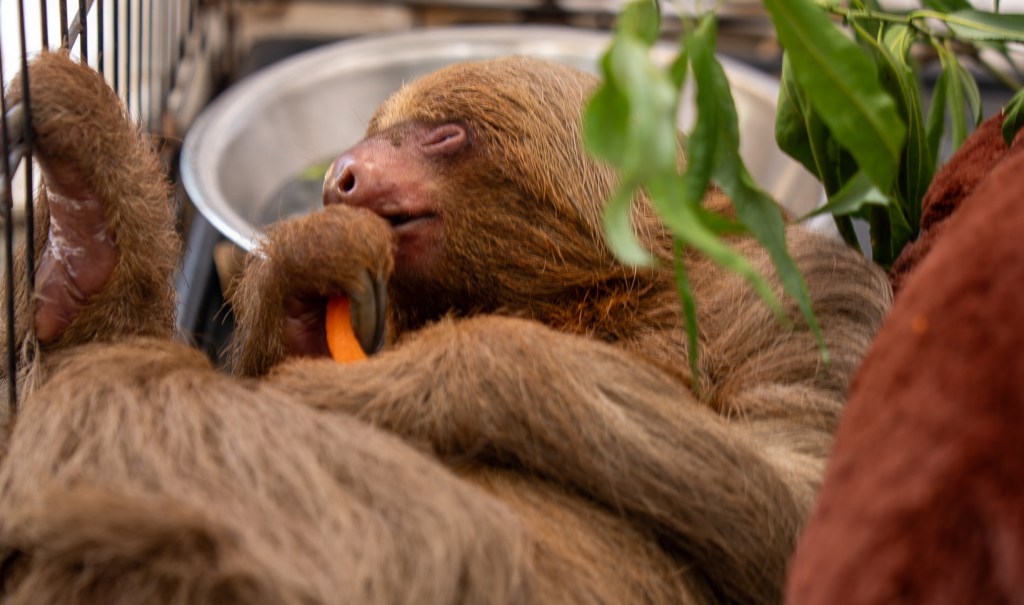
The Central Florida Zoo has a precious and fragile new resident. Thirteen sloths were moved there by their owners at Sloth World.
The planned International Drive attraction, which has not yet opened, has come under fire after a state report that 31 sloths died in a storage facility more than a year ago.
The animals, which were moved to the Sanford Zoo on Friday, are currently in a 30-day quarantine until next steps are determined.
Dr. Haley Straub, the zoo’s associate veterinarian, spoke to Orlando Sentinel reporter Dwayne Bevill about her experience managing sloth health.
Question: What do you look for in a sloth that might be sick? Are there any visible signs of distress?
Answer: Sloths are very unique animals, and I think the public perception is that they are slow and don’t move much. So it can be difficult to tell if your sloth is sick. They certainly show us signs when they are unwell.
What we’re looking for in sloths is very similar to what we’re looking for in other exotic animals. We monitor their vitals, heart rate, breathing rate, body temperature, behavior, normal interaction with the environment, appetite, thirst, and hydration levels. All of these things give you an idea of how stable the animal is. Of course, as with any animal, especially when these animals arrive, our job as veterinary staff is to triage and determine the stability of these animals. Certainly, there are some patients who require some degree of intensive care and quite aggressive supportive care, and we have provided that in our care.
Q: Rather than being relaxed, they are just shutting down because they are stressed, does this seem like a stressful situation?
A: They are certainly quiet animals, but they are also very sensitive animals. Therefore, any change in the normal environment or structure of daily life can be clearly seen as a stressful event.
It is difficult to define the level of stress an animal is experiencing. But I would say that this scenario brings about changes in their daily life. And I think that probably would qualify as a pretty stressful scenario given all the chaos that’s been going on.
Since they have come with us, our goal is to make them as comfortable as possible and give them time and space to acclimate to a healthy environment. And that’s one of our main priorities, and our animal care and veterinary teams work together to make sure that these animals feel comfortable, safe, and at home, working with us to make sure they have access to fresh, healthy food, water, sunlight, and they’re all responding very well to all of those changes.
Q: How would you describe the group when they present medically?
A: I think there was definitely a spectrum of what we were seeing clinically. Several animals required intensive life-saving treatment. Thankfully, the majority of the 13 animals in our care were well enough to be moved to their own locations, had adequate access to food and water, and did not require any additional supportive care from us from a veterinary standpoint.
But, as I said, there were certainly a variety of cases, and there were about four cases that initially required more intensive treatment and diagnosis.
Q: There have been reports that some other sloths have been infected with the virus. Do you want to test for that?
A: Viruses are usually species-specific. Of course, there is a long list of different viruses that animals and humans are susceptible to. It is very common for sloths as a species, rather than these animals in particular, to be diagnosed with a sloth-specific herpesvirus.
What I do know is that this group specifically has been reported to have previously tested positive for that virus. This is very common in this species, and it is difficult to determine if it has led to clinical symptoms.
Herpesviruses are one of the classes of viruses that exist. You can never actually get rid of it, but it can increase or decrease depending on severity and immunosuppression and stress situations. Therefore, it may be contributing to the symptoms of the disease. But I think there are probably more real causes of the disease than what’s happening to these animals. These include dehydration, nutrient and electrolyte imbalances, and what we call dysbiosis.
Q: Is one of the 13 sloths pregnant?
A: Honestly, it’s hard to tell at this point. It’s certainly possible. We have males and females of two different species here, but before they are with us, we don’t know if they have breeding potential. It is planned that all of these individuals will be X-rayed to confirm their potential as part of regular quarantine intake testing. But our priority at the moment is to give them time and space to relax and reduce their stress and response.

Q: Will there be many people around me during this 30-day quarantine period? What about other animals? What precautions are you taking?
A: A large intake of 13 animals of this type requires very strict quarantine protocols to protect our collection, staff, and of course the new animals. That’s why we have a dedicated and highly knowledgeable animal care team and veterinary staff who work exclusively with these new sloths at the Central Florida Zoo, keeping them completely separate from the animals already in our care. So we’re working around the clock on this new collection in our quarantine space.
By isolating the animals, it takes a lot of time because we have very careful personal protective equipment and our veterinary team has very strict protocols to keep everything confidential and to make sure it’s safe for all the animals and everyone involved. Currently, we have about 3 to 4 people per day. And then from the animal protection side, we have a dedicated, select group of animal caretakers and curators, and I think we’ll add about four or five more people. …
We also work with multiple veterinary nutritionists and sloth veterinarians and species advisors. That’s why the Species Survival Program (by the Association of Zoos and Aquariums) selects veterinarians and zoological experts for each species who are very knowledgeable about the care and nutrition these animals require, so we’re in regular contact with these key people to ensure they’re receiving the most appropriate diet possible.
Q: Do sloths have personalities?
A: Oh, absolutely. It’s so fun to have such a large group and see their personalities really start to show. I think they are slow and quiet, but they definitely have personality.
There are some in this group that are more mobile, more friendly, and always at the gate door whenever food comes. Some people might think you’re a bit lazy and just like to sleep.
Q: Are you seeing improvement within the group?
A: Without a doubt, from a medical perspective, many of these people are completely healed by proper nutrition, water, sunlight, and most of all, some much-needed TLC. All of these animals have shown improvement since their arrival.
Even in our most serious cases, it’s a sensitive issue and we work every day to do the best we can for the guy, but even he is showing improvement.
It will take some time before anyone on our team can say with confidence that these animals are 100% healthy, but we are all very optimistic and really proud of their progress. We maintain very strict monitoring so that we can jump at any time if we see a change in clinical status.
Q: Did the zoo share a photo of you bottle-feeding the sloth? Is it a daily occurrence for you or is it special?
A: This is a little glimpse into what we do as zoological veterinarians and animal caretakers, and it’s a reminder of how special our job is, and it’s certainly one among this new group of animals.
We have one pediatric animal. He is a sloth about 3 months old, a very young animal who will need a lot of support from us, including regular bottle feeding for the next 2 months. I am grateful that he is very energetic, responsive, and has a good appetite.
Sloth World won’t open following death of dozens of animals: report
One of the most important things we can do when caring for them is to provide proper temperature and humidity. They are very sensitive to changes in their environment and require the ability to self-regulate their body temperature. Luckily, we live in Florida and it’s summer right now, so outside is the perfect environment for them.
But for these little ones, we need to be a little more careful and make sure they don’t stay in warm and humid environments. So now our little friend is in an incubator. In fact, we moved her outside today for a few hours of a little sun, but she spends most of her time in the incubator to ensure the right temperature and humidity.
Q: This has become an international topic. Do you feel that way? Are people reaching out to you?
A: It’s really crazy to see the attention this is getting. I think that’s natural. And I’m so proud of my team here and everyone here for stepping up and doing what we’re working on. It’s not just an inspiration to everyone here, it’s an inspiration to the community, and it’s like an inspiration to the world.
dbevil@orlandosentinel.com
