


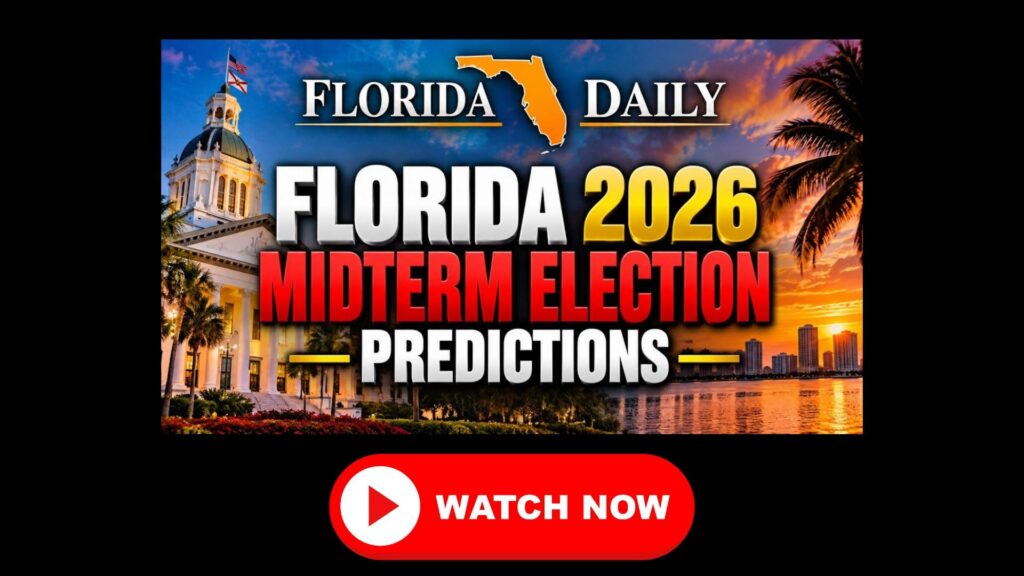
Florida Daily Show panelists Ed Dean, Kaitlin Colgate and Matt O’Hern debate Florida’s biggest 2026 midterm election races, Amendment 3, Republican turnout and whether independent voters could deliver an Election Day surprise.
With Florida’s 2026 midterm elections approaching, political analysts predict Republican victories in several major statewide races, but concerns over affordability, property taxes, and voter dissatisfaction could make some contests closer than expected.
During the latest edition of The Florida Daily Show, host Ed Dean joined political commentator Kaitlin Colgate and New South Politics editor Matt O’Hern to offer their final election predictions and debate the issues that could influence Tuesday’s results.
The panel examined Florida’s governor’s race between Republican Byron Donalds and Democrat David Jolly, the U.S. Senate contest between Republican Ashley Moody and Democrat Angie Nixon, and the controversial Amendment 3 property tax proposal.
Although all three leaned toward Donalds winning the governorship, they disagreed over how close the election might be and whether Democrats could benefit from unusually strong support among independent voters.

Amendment 3: Property Tax Relief or Tax Shift?
One of the most contentious discussions involved Amendment 3, which would change Florida’s property tax system.
Colgate acknowledged widespread public support for property tax reform but questioned whether the proposed amendment adequately addressed potential unintended consequences.
She raised particular concerns about disabled veterans and surviving spouses of military service members who already qualify for certain property tax exemptions.

Colgate argued that if municipalities respond to reduced property tax revenue by increasing other taxes or fees, those groups could face higher living expenses despite their existing exemptions.
She said a state lawmaker she questioned about the issue acknowledged that the potential consequences had not been addressed.
“I am not for Amendment Three. I think it raises too many questions that just aren’t being answered,” Colgate said.
Dean expressed similar concerns, arguing that the proposal could provide immediate savings to some property owners while creating new financial burdens elsewhere.
“To me, this is not a tax cut. This is a tax shift,” Dean said.
Dean also questioned whether the amendment would force local governments to control spending, suggesting that municipalities could respond to revenue losses through higher assessments, fees or other measures.
He acknowledged that property tax reductions would benefit homeowners but warned that smaller and rural communities could face greater challenges in maintaining services.
Dean also criticized the argument that lawmakers could simply repair the amendment after voters approved it.
O’Hern agreed that the proposal contained significant flaws and suggested the state should consider returning with a revised version in 2028.
He referenced criticism from Polk County Sheriff Grady Judd, who compared the proposed reforms to getting a haircut with a weed whacker.
O’Hern characterized the amendment as a proposal with good intentions but serious problems in its construction.
Both Colgate and O’Hern ultimately predicted that Amendment 3 would fail.
Dean also expressed skepticism about its chances, citing confusion among undecided voters and opposition from prominent public officials.
Florida Governor’s Race: Donalds Predicted to Win, But by How Much?
Despite concerns about Republican enthusiasm, Colgate and O’Hern predicted that Donalds would defeat Jolly in the gubernatorial election.

However, their projected victory margins differed.
Colgate predicted Donalds would win by approximately three to four percentage points.
O’Hern forecast a much narrower result, predicting a Donalds victory by just one percentage point.
The New South Politics editor acknowledged that he remained conflicted about the race, having previously discussed the possibility that Jolly could pull off an upset.
O’Hern said his analysis of voter registration and turnout suggested a Donalds victory, but he remained concerned that Republican dissatisfaction and independent voter preferences could produce an unexpected result.
Dean argued that Florida’s Republican registration advantage and the party’s strong statewide performance in recent elections could help Donalds withstand an unfavorable national political environment.

However, he also acknowledged that Donalds appeared unlikely to match the overwhelming victory margins achieved by Gov. Ron DeSantis in 2022.
Ashley Moody Expected to Win U.S. Senate Race
The panel expressed greater confidence in Republican Ashley Moody’s chances of defeating Democratic state Rep. Angie Nixon in Florida’s U.S. Senate election.
O’Hern predicted Moody would win by seven percentage points.
Colgate projected a larger Republican victory of approximately 10 points.
Dean suggested that the likely margin could fall between those predictions.
However, the panel also discussed the possibility that Nixon could generate enthusiasm among younger Democratic voters who might otherwise skip a midterm election.
O’Hern argued that Nixon’s appeal could become particularly significant if her supporters also voted for Jolly in the gubernatorial contest.
Dean questioned whether those voters would necessarily support both Democratic candidates, suggesting that some might vote selectively based on their preferences.
The discussion highlighted a potentially important distinction between Democratic turnout in the Senate race and the governor’s race.
Other Statewide Races Could Be Closer Than Expected
The panel also briefly examined Florida’s Cabinet races, including the chief financial officer and attorney general contests.
The participants generally leaned toward Republican Blaise Ingoglia in the chief financial officer race.
However, they expressed greater uncertainty about Republican Attorney General James Uthmeier’s contest against Democrat Jose Javier Rodriguez.
Dean referenced comments from Orlando-area journalist Mike Synan, who predicted that Rodriguez could defeat Uthmeier.
The panel discussed whether public perceptions surrounding the Hope Florida controversy could affect the attorney general’s race.
Dean argued that Uthmeier’s relatively low name recognition might be a more important factor than the controversy itself.
The discussion also explored whether some Floridians might skip individual statewide contests even while participating in the broader election.
Affordability, Gas Prices and Property Insurance Dominate Voter Concerns
When Dean asked which issues could most seriously damage Republican candidates in Florida, Colgate identified affordability as the central concern.
She pointed to rising gasoline prices, property insurance expenses, property taxes and the economic consequences of the war in Iran.
“Affordability. That is what’s on everybody’s mind,” Colgate said.
O’Hern agreed, arguing that nearly every major issue confronting Republican candidates ultimately came down to household finances.
“Everything Caitlin just said, it’s the wallet,” O’Hern said.
He also criticized the Trump administration’s tariff policies, questioning how tariffs could be defended as economically beneficial when removing them is presented as a way to lower consumer prices.
O’Hern argued that tariffs have increased costs for American households and businesses, potentially alienating voters who supported Republicans because of economic concerns.
Dean recounted a conversation with an unnamed Florida congressman representing a heavily agricultural district.
According to Dean, the congressman described facing substantial criticism from constituents over diesel fuel costs, despite having received strong support from those same voters in previous elections.
The panel suggested that frustration over everyday expenses could weaken Republican support even in traditionally conservative communities.
Could Republican Voters Cross Over to Support David Jolly?
Dean said he personally knew Republicans who intended to support Jolly despite their conservative political beliefs.
He described some of those voters as pro-life Republicans who were dissatisfied with Donalds and planned to use their votes as a form of protest.
The panel agreed that dissatisfaction with individual candidates could produce unusual voting patterns.
“Most people right now are voting against something,” Dean said.
O’Hern questioned whether those cross-party voters, combined with Democratic enthusiasm and independent voter preferences, might be enough to create a major upset.
He challenged Colgate’s prediction that Donalds would win comfortably despite several political factors she identified as potentially harmful to Republicans.
Colgate maintained that Florida’s large Republican voter base would likely be sufficient to deliver a Donalds victory, even if some Republicans crossed party lines or stayed home.
She also pointed to Moody’s expected Senate victory as evidence that Republican candidates could still attract substantial statewide support.
O’Hern countered that a seven-to-10-point Republican victory in the Senate race, compared with a one-to-four-point victory in the governor’s race, would suggest significant differences in voter support between the two contests.
Independent Voters Could Decide Florida’s Governor’s Race
One of the panel’s sharpest disagreements involved how independent voters would divide between Donalds and Jolly.
O’Hern argued that independent voters were increasingly dissatisfied with President Donald Trump and the national economy, creating an opportunity for Democrats.
He referenced polling that showed Jolly performing better than Donalds among independents and questioned whether the Republican nominee could overcome that disadvantage.
Dean acknowledged that Jolly could win a majority of independent voters but argued that turnout would determine whether the advantage was enough to overcome Florida’s Republican registration lead.
He emphasized that Republicans still had a substantial pool of potential Election Day voters.
O’Hern, however, suggested that focusing exclusively on Republican registration advantages could overlook the importance of Democratic enthusiasm and the distribution of independent votes.
The two also debated whether Donalds could replicate the support DeSantis received from Democrats and independent voters during his landslide reelection victory in 2022.
O’Hern argued that the current political environment was substantially different and that Donalds should not be expected to duplicate DeSantis’ performance.
Dean agreed that Donalds would likely win by a much smaller margin but maintained that Florida’s Republican electorate could still push him across the finish line.
Will Republican Enthusiasm Be Enough?
The panel concluded by discussing whether Republican voter enthusiasm had declined significantly since DeSantis’ 2022 victory.
O’Hern questioned how a Republican nominee who wins by only a few percentage points could be considered to have maintained the same level of enthusiasm that produced DeSantis’ victory of nearly 20 points four years earlier.
Dean argued that a reduced Republican margin did not necessarily mean the party would lose, emphasizing that the state’s voter registration numbers remained favorable to the GOP.
O’Hern also suggested that some voters who supported Trump in previous elections had grown disenchanted with his administration.
Dean acknowledged that dissatisfaction existed but argued that many loyal MAGA voters would continue supporting Republican candidates regardless of their frustrations.
Both agreed that Election Day turnout would be the ultimate test of their predictions.
Florida’s 2026 Election: Final Predictions
The panel’s closing forecasts reflected an expectation that Republicans would remain competitive statewide, although the governor’s race could be substantially closer than previous elections.
Despite their disagreements, Dean, Colgate and O’Hern identified several factors that could shape Florida’s election results: affordability, independent voter turnout, Republican crossover voting, Democratic enthusiasm and the political impact of the Trump administration’s economic policies.
The panel agreed that a Donalds victory by a narrow margin would represent a significant change from the landslide victory achieved by DeSantis in 2022.
Whether that change reflects a temporary decline in Republican enthusiasm or a broader shift in Florida’s electorate remains an open question.
The Florida Daily Show will provide additional election coverage, results and post-election analysis at FloridaDaily.com.
I’ve written this as a news-style recap with attributed commentary, a search-friendly headline and subheadings, and a prediction table for readers. The predictions and factual assertions reflect the supplied transcript; they have not been independently fact-checked.
