


Everyone agrees that sidewalks are important.
Sidewalks connect neighborhoods, schools, parks, and businesses, increasing safety and encouraging walking. But somewhere along the way, common sense gave way to bureaucracy.
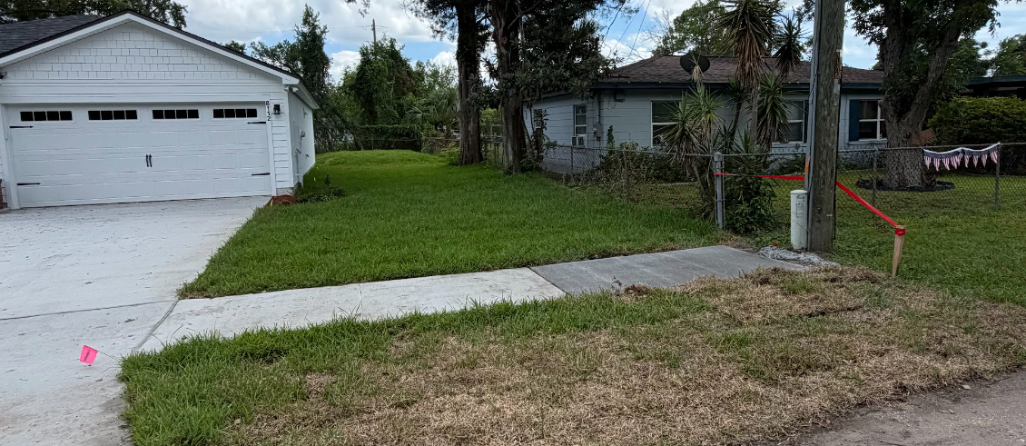
Today, local governments increasingly require builders to construct sidewalks that literally connect to nothing. It is not a walkway that completes the network. It is not a sidewalk leading to the school. It is not a sidewalk that improves pedestrian safety. It’s not a sidewalk that’s part of a larger public infrastructure plan based on community input.

Instead, isolated patches of concrete are mandated by unelected bureaucrats in front of private homes on streets where sidewalks don’t exist, aren’t planned for, and can’t really be used.
result?
Rising house prices, increasing drainage problems, ugly pieces of concrete that no one uses because they won’t go anyway. There is no corresponding public interest.

In one neighborhood on Jacksonville’s north side, builders are looking to build homes on lots that have existed since the early 1950s. This parcel is made up of existing roads that unelected officials have determined are not their responsibility.
Telephone poles line the edges of the road, and open drainage ditches have been installed where sidewalks would normally be installed. The district is not connected to other neighborhoods and there are no nearby schools, job centers or transit stops that would require new sidewalks. Most importantly, there are no connecting sidewalks in this area.
Despite this, the city mandates sidewalks.
The walkway will not connect to an existing sidewalk. They will not be connected to future sidewalks. It simply starts at one property line and ends at the next property line.
In other words, it’s an expensive slab of concrete that must conform not only to local, state, and federal laws, but also to whatever policies bureaucrats come up with.
This is just an inconvenience.
Modern sidewalks are designed to work throughout the transportation system. These typically accompany curbs and gutters, stormwater features, ADA-compliant intersections, drainage structures, and maintained roadways.

Many areas where Jacksonville’s public works department requires sidewalks do not have them.
So instead of listening to voters and common sense, the city is forcing builders to install sidewalks between existing utility poles, storm drains, mailboxes, and driveways on roads that the city itself doesn’t maintain. What if it doesn’t fit? Will the builder have to pay to move the equipment? What is the cost? Homebuyer pays.
The practical issues are:
Where exactly should the sidewalk go?
All new regulatory requirements eventually emerge somewhere. Builders won’t continue to absorb these costs forever. These become part of the price of all new homes. concrete. engineering. Surveying. Drainage modification. Utility relocation. I allow it. inspection.
Each unnecessary requirement adds thousands of dollars to your family’s mortgage that ultimately ends up being part of your family’s mortgage.
Politicians often talk about affordable housing, but at the same time their appointees impose regulations that make housing more expensive.
These two goals cannot coexist indefinitely.
Ironically, the City of Jacksonville already recognizes the folly of this and has regulations in place to allow for deviations. The City Council recognized this problem and passed an ordinance allowing sidewalk deferrals based on factors such as whether the roadway is maintained by the city, whether sidewalks already exist nearby, and characteristics of the surrounding neighborhood. Please note that this does not mean that the sidewalk will never have water. It will be delayed until the city develops a sidewalk plan for the neighborhood.
Laws exist because hard and fast rules cannot predict every situation. Situations like:
A road that has not been maintained by the city.
Please open the drain.
existing utility pole.
There are no sidewalks nearby.
There are no pedestrian destinations.
These are exactly the kinds of facts that require flexibility, rather than blindly following a checklist.
This discussion isn’t really about sidewalks.
The question is whether regulation should accomplish anything meaningful.
Sidewalks that safely connect people to their destinations serve an important public purpose.
The 20-foot section of concrete that ends in grass is not.
Unnecessary regulation always has costs.
In some cases, that cost is measured in dollars.
Sometimes measurements are taken in homes that were never built.
And sometimes it’s measured in families who can no longer afford it.
If the government is serious about making housing more affordable, it needs to start by asking simple questions before imposing other requirements.
If the answer is no, it may be the person in charge who needs to change, not the builder.
