


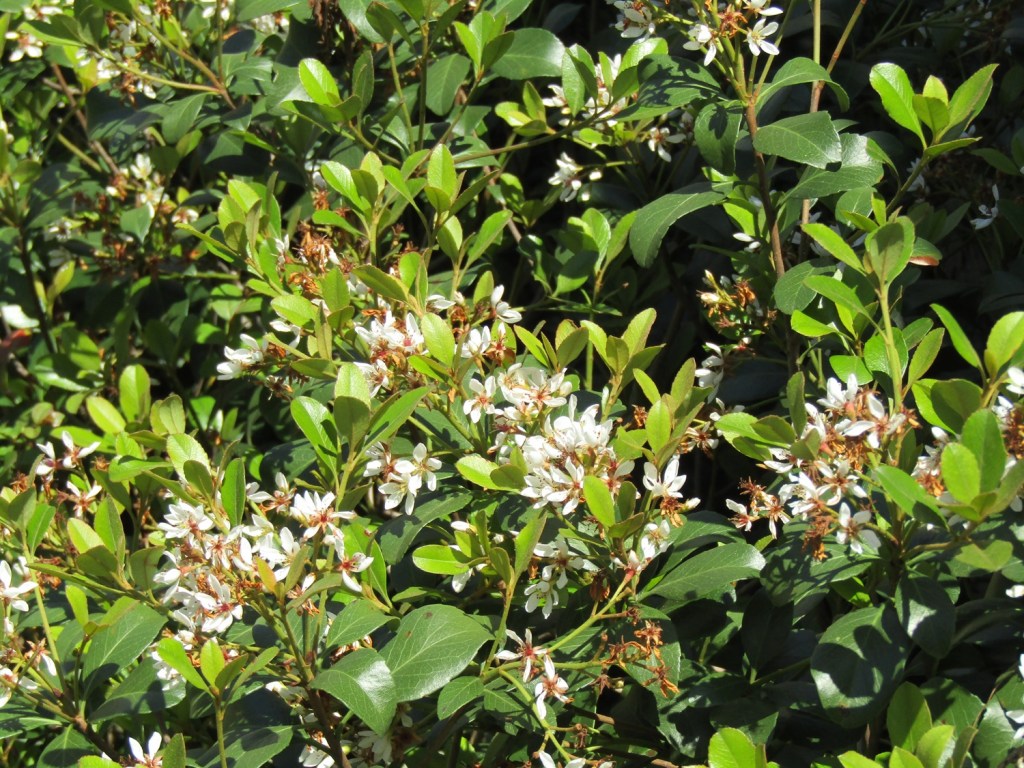
Q: Many of my landscape plants were damaged by the cold, and although many will recover, I don’t like the look of my brown shrubs. What low-lying shrubs were not damaged by February’s freeze?
A: Many gardeners like you don’t appreciate the look of brown landscapes. Unfortunately, the plants most affected were the colorful dwarf schefflera, croton, and ti plants. There are few colorful alternatives. The Indian hawthorn that is in full bloom now has white to pinkish flowers. Grows about 4 feet tall and about the same width. Gardeners have used it as a hedge and as a foundation plant. Additional low-growing frost-tolerant shrubs include dwarf yaupon holly, dwarf podocarpus, low-growing camellias, and rhododendrons. Acidic soil is important for azaleas to grow well. Tall plants that have survived the cold include viburnum, anise, and tea olives. Some of these have interesting seasonal blooms, and all can be kept within a 5- to 6-foot range. Still, you can also plant some colorful tropical plants or wait for the surviving plants to regrow.
Q: How long do petunias last? Will they make it in time for Easter?
A: These colorful plants for containers or in-ground beds should bloom from late spring to early summer, so I hope your petunias will bloom past Easter. How long it lasts depends on the care provided. All petunia plantings require moist soil, but not wet soil. It is best to water when the surface soil feels dry. Fertilize the plants in containers or in the ground every 3 to 4 weeks. By killing off fading flowers, you can extend blooming and the life of an attractive plant. Also, if the flower buds grow too long, cut them back and let them sprout from the base. Leave plenty of flowering buds to keep the plant attractive.
Botanist: It’s the best time to renew your crinum pruning
Q: I have an avocado tree that I grew from seed 7 years ago, but it hasn’t bloomed yet. The ground was frozen, but new green sprouts were visible at the base of the trunk. What should I do now?
A: Tree preservation begins by determining how much of the trunk has been damaged by freeze. Unfortunately, the tree may be dead close to the ground. Scrape the bark until you find an area of greenish-yellow to yellow moist tissue. Then cut the trunk back to this area. Most likely, this is where new growth has already begun to form buds. Continue until the buds are several feet tall. Then, around mid-summer, select one of the strongest buds to become a new tree. Make sure it is securely attached to the lower fuselage. Caulking may be required in some cases. Unfortunately, avocado seedlings take many years to bloom. It may be better to repot with a known variety that will flower and set fruit in just a few years.
Q: My giant stag beetle was in decent shape before February’s hard freeze, but it seems like it took a pretty big hit. I’m happy to have my puppy back. Please tell me how to raise my precious baby.
April in Central Florida Gardens
A: The email photo showed a large stag fern that was mostly completely brown on top and probably dead. There were many live puppies near the bottom of the fern. One option is to remove all dead bodies and cut back the main body of the fern. Then add sphagnum moss or soil to give the new shoots a place to grow. You can also transplant part of the puppy into this upper part. Another option is to cut the bottom of the plant, collect the leaves with roots and remove some of the pups. You can add these to a new wire frame filled with moss and soil to start your new plantings. Keep newly planted seedlings moist and fertilize with slow-release fertilizer at the indicated rate.
Q: My Tiboucina tree was blooming beautifully when I received the hard freeze. I cut off the tips of 3 or 4 branches, and the insides are green. How long will it take for green growth to appear again?
A: Unfortunately, many plant stems and twigs can trick us into thinking they are alive due to the green-looking parts beneath the bark. Make sure the tissue is also damp while it turns green. Tybouchina shrubs and trees usually put out new shoots quickly and begin to recover in a month or two after freezing during warm weather. You may need to look further down the stem or trunk to find healthy tissue and eventual shoots. Parts of the living shrub may be close to the ground.

Q: While pulling weeds in the garden, I grabbed some grass and burned my hand. It has mint-like medium green leaves. What is this weed? Are there any good ways to control it?
A: It’s hard to believe that such a seemingly benign plant can cause such severe pain. Nettles or nettle, as they are known, have hairs along their stems that release a stinging and burning compound when touched. The pain can last for hours and your fingers, bare feet, or other parts of your body may become numb. Some say they look similar to mint leaves or even strawberry leaves. Nettles are winter annuals that disappear during hot weather, but their seeds resprout in late fall. It is best to pull them out of flower beds and lawns wearing rubber gloves. Since it is under the influence of plants, wash the irritated skin and apply a soothing cream. Nettles can also be partially killed using a non-selective or broadleaf lawn herbicide according to label directions.
Q: This is my first time growing onions. When can I eat it?
A: A good question might be, what about onions, because onions are always ready? If you like green onions or new onions, harvest as many as you need when they reach the desired size. Many people grow onions from seed or harvest every other onion by transplanting them 1 inch apart during the growing season. The remaining plants are left to grow and form bulbs. The bulbs of onions begin to swell in late March and reach maturity in May. Although the crop can be harvested at any time, most gardeners leave the bulbs in the ground until the tops wilt and fall over.
Tom McCubbin is an emeritus urban horticulturist for the University of Florida Cooperative Extension Service. Write to Orlando Sentinel, PO Box 2833, Orlando, FL. 32802. Email: TomMac1996@aol.com.
