


As part of the Orlando Sentinel’s 150th birthday, on the first Sunday of each month, we will report on a topic that helped shape the Central Florida of today and how we covered that topic. This month, we cover tourism and theme parks.
Before there were thrill rides, costumed characters, nightly fireworks spectaculars and millions of out-of-towners, Central Florida had a very big draw for tourists: The sun.
The warmth and natural beauty of the Sunshine State drew Northerners seeking seasonal escapes and setting the table for Central Florida’s tourism industry to bloom. Decades later, Walt Disney’s strategic, secretive land purchases would ignite the transformation of Orlando into the “theme park capital of the world.”
Today, more than 75 million tourists travel to Orlando each year, filling more than 130,000 hotel rooms in the area and spending $60 billion at theme parks and other attractions. The hospitality industry employs more than 290,000 people. Tourists’ extended visits fill Orlando International Airport with arrivals and departures, jam roads with rental cars and fill local coffers with more than $380 million in tourism-tax dollars, some of which are used through Visit Orlando to entice even more people to come to Central Florida.
While the future could hold even more theme parks in Central Florida, a new business industry with reach far beyond Orlando has already been spawned. For now, just as it was in the early days of area tourism, there’s a sunny outlook.

Early attraction
In February 1884, not even a decade after Orlando was founded, a real-estate advertisement in the Orange County Reporter, a predecessor of the Orlando Sentinel, touted Sanford property as “lands to suit everybody – the invalid, tourist, fruit grower or farmer.”
A month later, the newspaper reported thousands of “northern people” in Orange County. Mostly, they were “tourists seeking to escape the rigors of a northern winter,” the paper said. Visitors were fairly affluent folks who would travel by steamship out of New York, stop at Charleston, South Carolina, or Savannah, Georgia, then disembark in Jacksonville, said Rick Kilby, an Orlando-based writer and graphic designer.
“The big thing was to go to Silver Springs up the Ocklawaha River,” Kilby said.
“As Central Florida started to develop, you could disembark in Sanford, and then it was a treacherous trip to get to Orlando from Sanford,” he said. “One of the things that kept Orlando from developing initially was because it was so hard to get here.”
In 1884, the Ocklawaha boats were so crowded that some tourists skipped that excursion, the newspaper said.
“No such season was ever before known in the state,” it read.

By 1935, Orlando had learned to entertain the snowbirds and created the Central Florida Spring Festival, a multi-night, flower-themed pageant at Tinker Field designed to “hold thousands of winter visitors until late in April,” the newspaper said. The event featured two stage shows, one in a 12th-century England setting that was “accurate in all details, including a thrilling tilting tournament on horseback,” according to the Orlando Morning Sentinel, which published a 12-page festival preview.
A second show revolved around the character of Lady Orlanda, Lady of the Azaleas, who welcomed nine “flower princesses” from neighboring communities, who performed musical segments with 100-person casts. Sanford did “Shamrock of Ireland,” DeLand presented “Lotus of Egypt” and Cocoa had a “Rose of Persia” scene.
Orlando Mayor V.W. Estes asked businesses to close at 4:45 p.m. so everyone could attend. General admission tickets were 50 cents. The Sentinel said it set an Orlando entertainment record — “the largest audience ever gathered at Tinker Field, overflowing every seat in the grandstand and bleachers.”

As transportation systems expanded on rails and roadways, more visitors made their way south. Roadside attractions became a Florida mainstay, Kilby said. Owners would sell citrus or show off wildlife, he said.
“The larger ones tended to be near places of great beauty, like Silver Springs or Cypress Gardens on the lake, and those are the ones that endured,” Kilby said. “But there were a lot of little mom-and-pop ones that sprang up.”
Travelers started pulling overnight trailers, but motels such as Wigwam Village — 27 teepee-shaped rooms on Orange Blossom Trail — were common. Destination postcards touted hotels, lakes, citrus trees and the streets of Orlando, doubling as advertisements to folks back home.
Enduring attractions of this era include Weeki Wachee Springs, Bok Tower Gardens and Busch Gardens in Tampa. In 1949, Owen Godwin opened the Florida Wildlife Institute, soon renamed Snake Village and Alligator Farm and then, in 1956, became known as Gatorland.
Godwin told the Orlando Sentinel-Star in 1952 that the Orange Blossom Trail attraction had free admission “so visitors can see a good slice of Florida without having to pay.”

Sky-high ambition
But change was in the air, literally.
Filmmaker Walt Disney famously flew over Central Florida land in 1963 to scout properties, possible stealth acquisitions for his Florida Project, eventually being known as Walt Disney World.
The Orlando Sentinel covered the public buzz surrounding the mysterious purchases of rural land southwest of the city. Among the speculated-upon buyers were Boeing, Ford Motor Co. and billionaire Howard Hughes.
Front-page headlines in the Oct. 21, 1965, edition of the Sentinel were “Is Our ‘Mystery’ Industry Disneyland?” and “Girl Reporter Convinced By Walt Disney.” Emily Bavar, editor of the newspaper’s Florida Magazine, had face-to-face denials from Disney, but also stacks of clues from him that suggested otherwise.
Four days later, Florida Gov. Haydon Burns confirmed Bavar’s prediction. So the Oct. 26, Sentinel headline was “It’s Official: This Is Disney’s Land!”
At the same time, Walt Disney Productions said there were details to iron out and that other locations were being considered … but there would be an announcement in Orlando on Nov. 15.

In November 1965, Walt Disney, Florida Governor Haydon Burns and Roy Disney held a press conference in the Egyptian Room at the Cherry Plaza in Orlando. Disney announced plans for Disney World and promised the theme park would be grander than Disneyland. (Orlando Sentinel file)

Walt Disney, left, talks with Gov. Haydon Burns, center, and Orlando Sentinel publisher Martin Andersen in the fall of 1965 at a reception to celebrate the announcement of Disney’s Florida plans. The event took place at the now-gone Egyptian Room of the hotel on Lake Eola most often remembered as the Cherry Plaza. (Orlando Sentinel file)

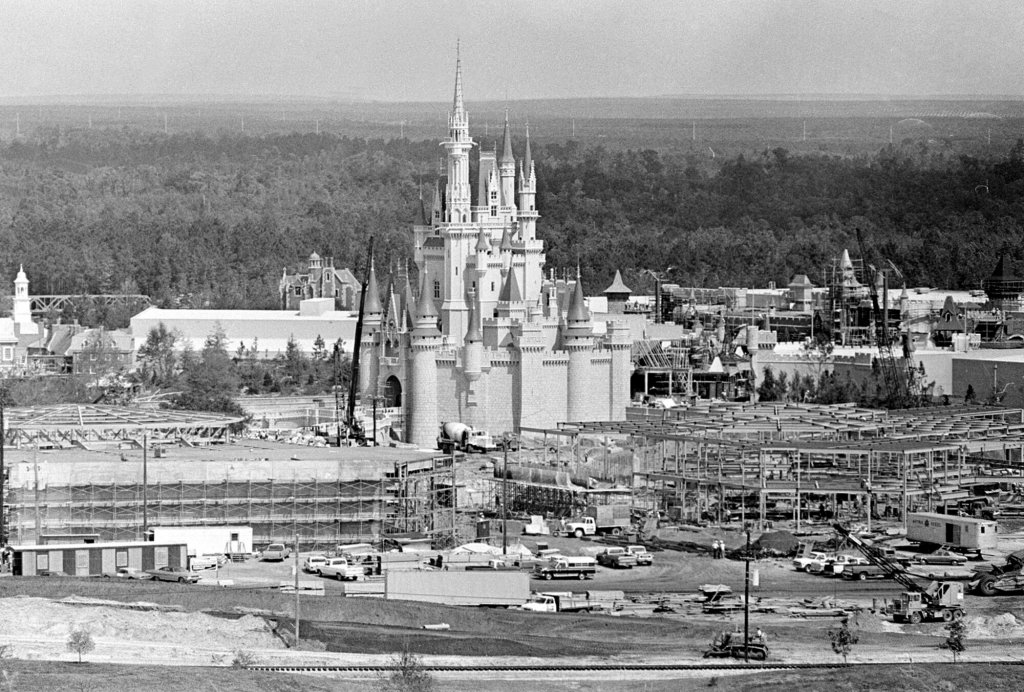
Magic Kingdom and Cinderella Palace under construction at Walt Disney World. (New York Daily News)

Construction of Space Mountain at Disney World’s Magic Kingdom in underway on Aug. 24, 1973. (Orlando Sentinel file)

Walt Disney World landscapers move the 64,000 pound Liberty Oak into the Liberty Square section of Magic Kingdom. (Walt Disney Co.)

Construction of Space Mountain at Disney’s Magic Kingsom in 1974. (Sentinel Star)

DISNEY WORLD’S MAGIC KINGDOM: A welder works on the construction of a restaurant in Walt Disney World’s Magic Kingdom as Cinderella Castle takes shape in the background. The park opened in 1971. (Orlando Sentinel file)

Construction workers prepare Cinderella Castle in Walt Disney World’s Magic Kingdom in December 1970. (Orlando Sentinel file)

Eastern seaboard architecture of turn of the century America is being recreated in Main Street U.S.A. at Walt Disney World’s Magic Kingdom theme park in Central Florida, November 1970. (Orlando Sentinel file)

The Haunted Mansion, under construction in this photo, was an opening-day attraction at Magic Kingdom in Walt Disney World, where it is part of Liberty Square. It features a ride-through tour in Omnimover vehicles called “Doom Buggies”, and a walk-through show is displayed to riders waiting in the line queue. (Orlando Sentinel file)

The Walt Disney World Railroad opened to the public for the first time on Oct. 1, 1971, the same day that the Magic Kingdom park opened. Its route is 1.5 miles in length and encircles most of the park, with train stations in three different park areas. The attraction’s locomotives were acquired from a narrow-gauge railroad system in Mexico. After being shipped to the United States, they were altered to resemble locomotives built in the 1880s and restored to operating condition. (Walt Disney World)

The monorail system at Walt Disney World pictured in 1971. (Walt Disney World)
1 of 12
In November 1965, Walt Disney, Florida Governor Haydon Burns and Roy Disney held a press conference in the Egyptian Room at the Cherry Plaza in Orlando. Disney announced plans for Disney World and promised the theme park would be grander than Disneyland. (Orlando Sentinel file)
Expand
That morning, Walt Disney again flew above the 30,000 acres Orange and Osceola County purchased by dummy corporations. At 2 p.m., he held a news conference alongside Burns and his brother Roy Disney at the Cherry Plaza Hotel in downtown Orlando.
The event was thin on details, but the announced investment was $100 million.
Less than six years later, Magic Kingdom theme park opened to the public.
Within 50 years, the Lake Buena Vista resort contained four theme parks, two water parks, a shopping district and 30,000 hotel rooms. Disney World now employs about 80,000 workers.
“It’s all happened slowly … but it’s been a consistent growth overall,” said Jeff Vahle, current president of Walt Disney World. He moved to Florida at age 9.
“When I grew up, and I would drive up (U.S.) 27, it was all orange groves … and the Citrus Tower didn’t overlook houses,” he said.
Disney World, Orlando and their visitors have matured together, Vahle said.
“They’ve grown up with us over those 50 years … and keep coming back,” he said.

Fifty-year veteran clown Lou Jacobs and Michu, The Smallest Man In The World, both featured performers with “The Greatest Show on Earth, “push” a plodding pachyderm to work at the Barnum City, Florida construction site of Ringling Bros. and Barnum & Bailey Circus World in 1989. (Ringling Bros. and Barnum & Bailey)

Ringling Bros. and Barnum & Bailey Circus World, themed from “The Greatest Show on Earth,” is a most unique theme park located in Barnum City at the intersection of Interstate 4 and US 27. (Ringling Bros. and Barnum & Bailey)

Baseball legend Ted Williams inspects a larger-than-life picture of himself in the Baseball Hall of Fame at Boardwalk and Baseball in Haines City on April 21, 1987. (Orlando Sentinel file)

The half-mile stone replica of the Great Wall of China, pictured on Dec. 1, 2004, and other leftovers from the shuttered Kissimmee theme park Splendid China were auctioned off about a year after the park closed. (Orlando Sentinel file)

Visitors enjoy Splendid China on Dec. 30, 2003. The park closed on Dec. 31, 2003. (Orlando Sentinel file)

The Boardwalk and Baseball attraction in Haines City closed on Jan. 17, 1990. (Orlando Sentinel file)

Actor Les Chavelday portrays Jesus at The Holy Land Experience, a Bible-based tourist attraction southwest of Orlando, Florida. (Orlando Sentinel file)

Rosie O’Grady’s owner Bob Snow draws a beer in 1975, happier days for the Goodtime Emporium at Church Street Station. (Orlando Sentinel file)

Guests walk into Pleasure Island in Downtown Disney in 2011. (Stephen M. Dowell/Orlando Sentinel file)

A swimmer makes his way across the cool waters of River Country at Walt Disney World’s Fort Wilderness Resort in February 1989. (Walt Disney Co.)

Two men stand together and spread their arms to given an indication of the size of The Senator, a giant bald cypress tree at Big Tree Park in Seminole County north of Longwood. The photo is from the 1920s. (Florida State archives)

BOB FREY, ORLANDO SENTINEL
A sign indicating The Senator, one of the world’s oldest and tallest bald cypress trees, is seen in Seminole County.
1 of 12
Fifty-year veteran clown Lou Jacobs and Michu, The Smallest Man In The World, both featured performers with “The Greatest Show on Earth, “push” a plodding pachyderm to work at the Barnum City, Florida construction site of Ringling Bros. and Barnum & Bailey Circus World in 1989. (Ringling Bros. and Barnum & Bailey)
Expand
The next wave
Walt Disney was a proven winner with groundbreaking animation, his Disneyland concept in California and success at the 1964 New York World’s Fair. Other entertainment companies soon followed Disney to Orlando.
SeaWorld, which had a marine park in San Diego, opened another one about 8 miles east of Magic Kingdom in 1973.

“We stayed with the mission from day one til now, and that’s to educate, celebrate and hope and care for animals in need,” said Jon Peterson, SeaWorld Orlando’s park president.
“That’s the story that has continued to bring our customers back, year after year, day after day, for the same love that we have of the ocean,” he said.
Many Orlando-area theme parks and attractions didn’t last as long. Gone are varied places such as Circus World, Florida Splendid China, Holy Land Experience, Dolly Parton’s Dixie Stampede dinner show and Terror on Church Street.

Church Street Station, a collection of nightclubs and entertainment venues that were tourist magnets, had a lengthy run after founder Bob Snow was drawn to an abandoned train depot in downtown Orlando.
“To me, it’s kind of a full-circle moment, where you go from tourism starting at the train station, going to Bob Snow, going back because the train station was there,” Kilby said.
After several ownership shifts, the attraction faded away in the Y2K era. A common theory was that tourists found options at Disney’s Pleasure Island and Universal CityWalk more appealing.

Gatorland sign shown in 1979. (Orlando Sentinel file)

Gatorland founder Owen Godwin poses with the original Bonecrusher, who was 15 feet long, in the early days of the South Orange Blossom Trail attraction. (Gatorland)

Owen Godwin, owner of Gatorland, is shown in 1958 with a South American spider monkey, one of the many specimens of wildlife from Florida and all over the world displayed at his attraction. (Orlando Sentinel file)

Alan Swingle, left, and John Trembley check out a stuffed version of an alligator at Gatorland on July 4,1979. (Orlando Sentinel file)

Photo taken at Gatorland in Jan. 20, 1978. (Orlando Sentinel Star file)

The Chicken Jumperoo at Gatorland shown in 1983 (Orlando Sentinel Star file)

An aerial photo of Gatorland on May 15, 1962. (Orlando Sentinel file)

Albert the Galapagos Tortoise always is ready for a handout at Gatorland. Photo taken in 1977. (Orlando Sentinel file)

Owen Godwin, left, and Jack Godwin handle a snake at Gatorland in 1957. (Orlando Sentinel file)

Shannon Bailey holds at snake at Gatorland in 1979. (Orlando Sentinel file)
1 of 10
Gatorland sign shown in 1979. (Orlando Sentinel file)
Expand
The wealth of entertainment offerings affected the business of Gatorland, said Mark McHugh, the company’s president and CEO. The park, born in the roadside attraction phase, also navigated the megapark years when four Disney and Universal parks opened within a 10-year span.
“The competition just almost killed us in the ‘90s,” McHugh said. “People prior to that went on vacation, and they had an extra day or two to go to Gatorland. … It almost put a nail in us.”
The attraction then re-emphasized natural beauty and down-home Florida hospitality, he said.
“I think that’s something that people like when they come here. We kind of courted that old roadside history,” McHugh said.
But, big picture, the presence of the big parks helped Gatorland, he said.
“Without Disney, we would have been gone a long, long time ago. … There’s no doubt,” McHugh said.

The 32-foot, 3-ton Great White Shark at Universal Studio’s “JAWS” is pictured in 1993. (Universal Studios Florida)

Progress continues on construction at Universal Studios Florida on Nov. 1, 1989. A worker sprays a fresh coat of paint onto the Beverly Wilshire Hotel along Hollywood Boulevard, which is part of them backlot attraction. Universal Studios Florida opened on June 7, 1990, as a theme park that lets visitors “Ride the Movies.” The themes of Universal Studio’s are targeted at making guests feel like they are in a movie set with rides, shows, and attractions inspired by popular film, television, and music productions. (Orlando Sentinel file)

Tom Wilson, who plays “Biff” in the Back to the Future movies, clowns around with Michael J. Fox at the Universal Orlando Grand Opening on June 7, 1990. (Orlando Sentinel file)

Universal Studios grand opening on June 7, 1990. (Orlando Sentinel file)
1 of 4
The 32-foot, 3-ton Great White Shark at Universal Studio’s “JAWS” is pictured in 1993. (Universal Studios Florida)
Expand
The brashest player of recent times has been Universal Orlando, which has constructed three theme parks, a water park, an entertainment district and nearly a dozen hotels since 1990. First up: Universal Studios Florida theme park.
“It was a little bit of a rough opening, but I would say probably into the first year, we were already well on our way to planning expansion,” said Karen Irwin, now president and chief operating officer of Universal Orlando.

The sheer number of tourism players makes Orlando a unique market.
“Orlando is just different. It’s partly its scale. It’s partly the innovation, which is phenomenal,” said Alan Fyall, associate dean of the Rosen College of Hospitality Management at the University of Central Florida.
“But I put a lot of it down to the intangible. It’s the collaboration. I’ve worked in many big cities around the world. It’s different here.”

Confetti showers over guests at the entrance of Super Nintendo World at Universal’s Epic Universe, welcoming them during a media preview event on May 20, 2025. (Rich Pope/Orlando Sentinel file)

Mine-Cart Madness at Super Nintendo World takes guests on a fast-paced ride through Donkey Kong Country at Universal’s Epic Universe during a media preview event on May 20, 2025. (Rich Pope/Orlando Sentinel file)

The Constellation Carousel is one attraction within Celestial Park, the central hub of Universal Epic Universe on April 21, 2025. Orlando’s first new theme park in a generation is set to open to the public on May 22. (Patrick Connolly/Orlando Sentinel file)

Guest ride the Stardust Racer Rollercoaster at Epic Universe in Orlando on May 21, 2025. (Orlando Sentinel file)

Fireworks launch over Universal’s Epic Universe on May 21, 2025, on the eve of the theme park’s grand opening to the public. Epic is the first major new theme park in the US in more than 20 years. (Joe Burbank/Orlando Sentinel file)

Excited guests at Universal’s Epic Universe on May 22, 2025, quickly make their way to the main entrance portal shortly after the 6:30 a.m. grand opening of the park. (Rich Pope/Orlando Sentinel file)

Theme park guests take in the sights and wander through Celestial Park at Universal Epic Universe on Aug. 27, 2025. (Patrick Connolly/Orlando Sentinel file)

Universal opened the Stella Nova Resort, pictured above, by the entrance to Epic Universe in January. (Rich Pope/Orlando Sentinel)

The Dragon Racer’s Rally ride soars and spins above How to Train Your Dragon – Isle of Berk at Universal’s Epic Universe during a media preview event on May 20, 2025. (Rich Pope/Orlando Sentinel file)

Performers entertain the crowd during the LeCirque Arcanus show inside the Harry Potter – Ministry of Magic themed land at Epic Universe in Orlando on May 21, 2025. (Orlando Sentinel file)

Some of the first guests at Universal’s Epic Universe line up at the ticket kiosks shortly before the 6:30 a.m. grand opening of the park on May 22, 2025. (Rich Pope/Orlando Sentinel file)

Universal Orlando officially opens Epic Universe and the Super Nintendo World in Orlando on May 22, 2025. (Orlando Sentinel file)

Hiccup from How to Train Your Dragon – Isle of Berk at Universal’s Epic Universe welcomes guests during a media preview event on May 20, 2025. (Rich Pope/Orlando Sentinel file)

The goddess Luna in the Celestial Park at Universal Epic Universe during soft opening, on April 22, 2025. (Ricardo Ramirez Buxeda/ Orlando Sentinel)
1 of 14
Confetti showers over guests at the entrance of Super Nintendo World at Universal’s Epic Universe, welcoming them during a media preview event on May 20, 2025. (Rich Pope/Orlando Sentinel file)
Expand
From here?
Orlando reigns as the theme park capital of the world, but could big get bigger? Some experts expected Disney World to announce a fifth park in the wake of Universal expansion or even a rapid addition to Epic Universe, which opened last year.
Executives won’t officially go there yet. Disney has announced projects, some of which visitors can see under construction at Magic Kingdom, Disney’s Animal Kingdom and Disney’s Hollywood Studios theme parks. They have ties to “Encanto,” “Cars,” “Monsters, Inc.” and Indiana Jones films.
Vahle, the WDW president, said the company’s park plans aren’t driven by intellectual property – its characters or movies.
“You kind of go look at and say, ‘What’s the park or a property need, and then what’s a great idea to fill that need?’” he said.

Solid plans exist for Disney World – some already announced, some not – through about 2033, he said.
“We always have to stay that far ahead as you think about how long it takes to design something and build something,” Vahle said. “So the things that we’re thinking and talking about now are 2034 through 2040.”
Universal also has multiple projects in the pipeline, Irwin said.
“They are years in the making, and they’re big investments. … We do have quite a few on the books right now for all of our parks in Orlando,” she said.
“I’ve been doing this for almost 36 years now, and I’m incredibly excited about what’s in the plan,” Irwin said.
Hidden hub
Although eye-catching theme park architecture and flashy rides hold tourist attention, the Orlando market has surged in tourism businesses that provide behind-the-scenes creativity for attractions here and beyond Central Florida, experts say.
“There’s a talent pool here, and there’s a lot of available talent, post Epic,” said Adrian Jones, managing director of CONDUCTR, an interactive design agency based in Manchester, England, with an Orlando office.
“I think the fact that we’ve got a hub in Orlando is extremely important for us as a business because not only does it make it that we’re in the hub of technology advancements in the best theme parks in the world, but also the talent,” Jones said.
Universal Creative workers based in Orlando are involved with Universal’s projects elsewhere, including the year-round haunt in Las Vegas, the kids’ parks in Texas and the proposed theme park in England. Many Walt Disney Imagineering plans for worldwide projects are created by folks based in Central Florida.
“Orlando isn’t just a place where people come and play and have fun. It’s an industry, a knowledge hub,” said UCF’s Fyall. “Increasingly, people from around the world, a lot from the Middle East and Japan, they’re coming here to see how it’s done.”
Jakob Wahl, chief executive officer of the International Association of Amusement Parks and Attractions, thinks the future of Orlando is beyond Orlando.
“Fifty years from now, people won’t just look back at Orlando as the theme park capital of the world,” he said. “We think they’ll point to it as a place where the future of tourism and the future of attractions actually was built.”
Challenges and changes
Moving forward, the tourism industry faces a shifting list of challenges. Current hot topics include political turmoil, affordability, international travel competition, changes in technology and consumer tastes.
“I think price and value proposition are the things globally that we just got to keep an eye on,” Jones said.
“Ten years ago, Saudi Arabia and Middle East, they were all about, how do we become the next Orlando?” he added. “They are basically spending vast amounts of money on the biggest, the longest, the fastest, the this, the that, the other.”

Jennifer Parnell, Rescue Specialist at SeaWorld Orlando, bottle feeds an orphaned manatee at SeaWorld Orlando at 3 a.m. on Sept. 21, 2017. The young manatees have to be fed every 3 hours with workers taking care of the animals around the clock. (Orlando Sentinel file)

SeaWorld Orlando’s Gary Violetta. curator of fishes for SeaWorld, checks out an endangered Kemp’s Ridley turtle, one of 11 that were transported by airplane to Orlando Executive Airport from the Gulf of Mexico on June 25, 2010. In a joint effort between SeaWorld Orlando, Disney’s Animal Programs and the Institute for Marine Mammal Studies in Gulfport, Miss., the turtles, suffering from pneumonia, were moved from the rehab facility to make room for other animals affected by the Gulf oil spill. 9 of the turtles — who were rescued in Ocean Springs, Miss., will be rehabilitated at SeaWorld Orlando; 2 at Disney’s The Seas facility at Epcot. The Kemp’s Ridley turtle is the most endangered in the world. (Joe Burbank/Orlando Sentinel file)

In the exhibit’s natural habitat area for recovered manatees, a guest in the underwater viewing area reaches out to a recovered manatee rehabbed at the SeaWorld Orlando Animal Rescue Center, photographed Aug. 5, 2021. In July, the Florida Fish and Wildlife Commission (FWC) reported 866 manatee deaths so far in 2021 — the highest death toll ever recorded in the state in a single year. (Joe Burbank/Orlando Sentinel)

A small crowd watches as a hundred–pound Loggerhead turtle returns to the ocean at Canaveral National Seashore, during a release by SeaWorld Orlando on March 11, 2011. The animal marks the 1,000 turtle rescued by SeaWorld and returned to the wild since 1980. SeaWorld released a total of 7 turtles at Cape Canaveral, near Kennedy Space Center. (Joe Burbank/Orlando Sentinel file)

A Team from SeaWorld Orlando release a manatee into the Indian River at Kennedy Point Park in Titusville on May 6, 2015.The manatee was rescued in January in Oak Hill, FL and rehabilitated at SeaWorld. (Orlando Sentinel file)
1 of 5
Jennifer Parnell, Rescue Specialist at SeaWorld Orlando, bottle feeds an orphaned manatee at SeaWorld Orlando at 3 a.m. on Sept. 21, 2017. The young manatees have to be fed every 3 hours with workers taking care of the animals around the clock. (Orlando Sentinel file)
Expand
While SeaWorld has continued its animal rehabilitation efforts — it has recorded more than 42,000 rescues — it has expanded its ride lineup as public opinion has evolved.
“I think every business looks at their day-to-day operations, year over year, have adjustments to them to what the economics are going on, but also what the perception is,” said Peterson, the park president. “We have adapted to what our guests are looking for.”
“I believe that our success over the last 10 years or so, and especially our success growing in the future, is going to depend on diversification of those entertainment experiences,” said Gatorland’s McHugh, who points to cultural tourism and sports opportunities.
Look for theme parks to remain king, though.
“I think there is a continued need for people to have fun, to be distracted, to enjoy time with each other,” IAAPA’s Wahl said.
“The city has the mindset to attract people, to attract visitors here, to make them feel welcome and to make them have a good time.”
Email me at dbevil@orlandosentinel.com. BlueSky: @themeparksdb. Threads account: @dbevil. X account: @themeparks. Subscribe to the Theme Park Rangers newsletter at orlandosentinel.com/newsletters.
