


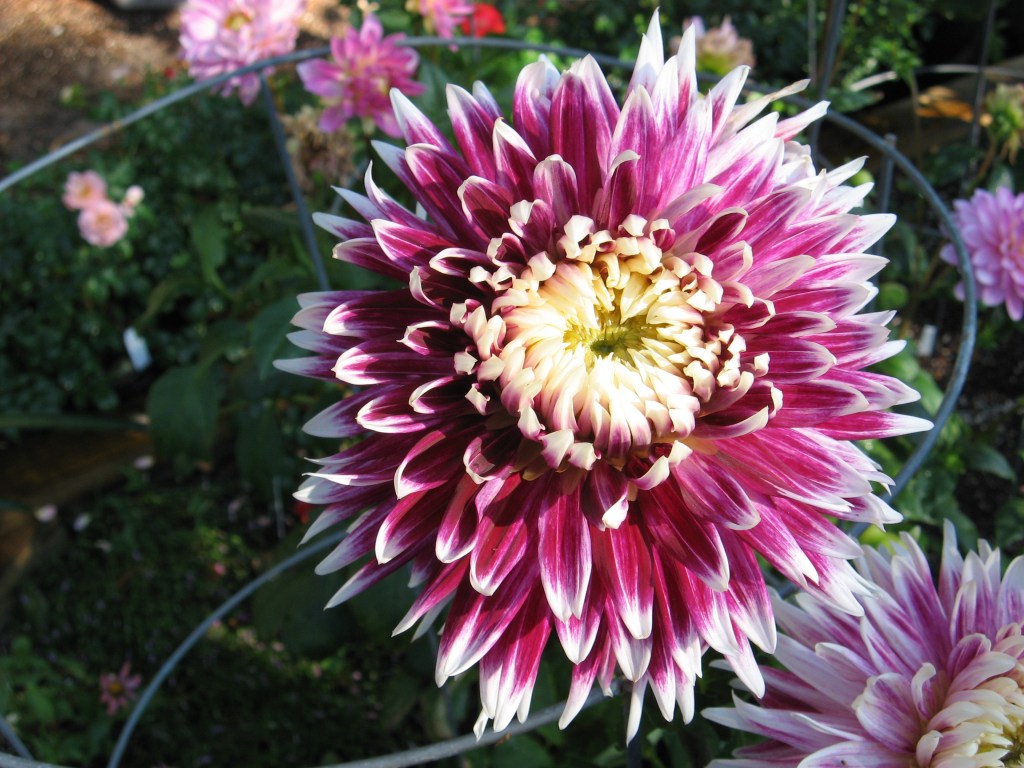
Q: Big dahlia flowers are our favorite. How well does it grow in Central Florida? What kind of care does it require?
A: Dinner plate-sized dahlia flowers, along with their smaller counterparts, are a favorite of many gardeners, especially those who have immigrated from northern states. But locally that can be a challenge. Dahlias do not like summer heat and humidity. In addition, they do not overwinter in the ground or in stored tubers. If you’re a gardener with fond memories of dahlias and would like to try them, obtain tubers from your local garden center or mail order retailer. Plant the tubers in well-drained soil that has been amended with organic matter such as compost or manure. Keep new growth moist and fertilize with a slow-release product according to label directions. A trellis or stake is required to maximize plant growth and flowering. You can enjoy the flowers of plants or use them as bouquets. Unfortunately, dahlias suffer and decline during the rainy season. It will need to be replanted the following spring.
Q: I have a frozen seedling avocado tree that is about 12 feet tall. Some people say they will grow back if left alone, while others cut them back 4 feet or more. What should I do?
A: Perhaps a combination of well-intentioned advice will help determine the extent of freeze damage and chances of survival. The real job is to find out how far along the stem or trunk the avocado is frozen. Use a knife to scrape the stem and trunk, looking for green tissue under the outer bark. Stem tissue is greenish to light brown and may be moist. If the tissues of the limbs and trunk are dark brown and dry, it is dead. Once you have determined how far the branches and trunk are dead, you can make any necessary pruning. Cut back below the dead area (to 4 feet or close to the ground). This was a sapling, so if it grows from the base it should produce a tree like you remember.
Plant Doctor: This long-lasting begonia in your home or garden is a star with or without flowers.
Q: This year, the azaleas are blooming a lot and seem to be growing well. Should I use it instead of frozen shrubs?
A: Thanks to the cold weather in February, the azaleas bloomed well. Azaleas seem to prefer colder climates, allowing their flower buds to mature and open evenly to produce spectacular blooms. Azaleas are popular shrubs, but they have fallen out of favor in recent years due to cultural requirements. If you’re thinking of replacing your frozen shrub with an azalea, make sure you repot it in acidic soil. Check soil pH and apply acidifying products, such as soil sulfur, as recommended by your soil test, if necessary. Adding organic matter and pine bark particles to the soil can make it more acidic. Once the soil has improved, add the azaleas and water frequently to keep the root ball moist. Rhododendrons require about 1 to 2 years of continued care to become established in your local soil.
Q: I want to sow seeds in my sandy backyard. Do you add organic matter to the soil first?
A: Sandy soil seems to absorb organic matter. Therefore, it has limited value when starting a new lawn. It’s fine to till with a few inches of well-decomposed organic matter such as compost or peat, but after a few months the soil will return to being primarily sand. It’s probably more important to till the soil before planting, mixing in a top layer 4 to 6 inches deep and adjusting soil acidity as needed. Next, focus on keeping the soil moist during germination and establishment of your new lawn.

Q: My tree-sized, yellow, flowering landscape plants have been blooming for several weeks now. What is this tree? When will it be planted?
A: The eye-catching yellow Tabebuia begins blooming in late February. As I remember, pink Tabebuia bloomed from January until February when it froze. Yellow Tabebuia is cold sensitive, but the buds appeared to have been dormant enough to survive the damage. There are several types or species of yellow tabebuia. Look for new trees at your local garden center, but make sure they have some winter hardiness. Now is a good time to add Tabebuia to your landscape. It can be planted in a sunny location throughout the year.
Q: My amaryllis has finished blooming. How do I care for my plants and leftover flower stalks?
A: If you keep your amaryllis in a container or place it in a light shaded area of your garden, it will bloom again in about a year. Most amaryllis plants grow well in containers 6 inches or larger filled with a suitable potting mix. Feed with a slow-release fertilizer according to label instructions. Fertilizer application is usually required in March, May and August. Keep the soil well maintained during the summer, and water only when the surface dries until the plant blooms in the fall and winter. Most gardeners remove the thick flower stalks by cutting them off as they enter the leaf clumps. If seed pods have formed, some people leave the stems until the pods turn brown and are ready to sow. If you want to grow more amaryllis and enjoy them, seeds are easy to germinate, but it takes about three years to develop flowering bulbs. After harvesting the seeds, remove the stems.
Tom McCubbin is an emeritus urban horticulturist for the University of Florida Cooperative Extension Service. Write to Orlando Sentinel, PO Box 2833, Orlando, FL. 32802. Email: TomMac1996@aol.com.
