


The experience of hummingbirds soaring past your head at what seems like caffeine-induced, time-altering speed is like hovering in the median of a bumblebee superhighway.
Vvvvvmmmm!
Vvvvmmm!
It is fast. And surprisingly loud.
In the Mashpi cloud forest of Ecuador, there are more than 30 species of hummingbirds. And the breathlessness I experience when first beheld reminds me of the first time I saw a tropical reef, teeming with color and life that I’d seen a zillion times on the nature programs I have loved my entire life, but this time in person.
I smiled reflexively then … and my mask filled entirely with water. That’s not a concern here.
In this moment, as dozens of them soar, like brilliant beads in a high-speed kaleidoscope amid the feeders placed before me and the other guests of the Mashpi Lodge, 70 miles northwest of Quito, the nation’s capital. They dart and hover and land within a foot of my face.

They are like faeries. Territorial little war faeries, bullying one another away from the flower-shaped openings, fueling what has been documented by scientists as the highest metabolism of any animal, consuming up to half their body weight in sugar daily to power wings that beat 50 to 80 times per second.
Vvvvmmm!

There are four at this feeder, with lots of sharing room, but aggression still reigns. No one is harmed in this war dance. The aerial scuffles are charming.
In the moments they are still, which still seem like odd visual effects where the turn of a small head appears as a video with a second of frame removed, they land on my hands. I feel their tiny talons, but their weight is imperceptible.

There is a purple-bibbed white tip, the tiniest of the lot, with a dominant color of deep green; two velvet purple coronets, so vivid in emerald and sapphire they seem unreal — until you gaze at the violet tailed sylph, which in the moment I have deemed “the blue mohawk bird,” with its delicate crest, its green and blue and purple hues, blinding in the sun, its extra-long tail that stretches out behind it like a narrow train on a tiny monarch’s cloak.

I sit rapt for minutes amid this little avian scrum when a crimson-rumped toucanet and a tayra (a beefy relative of the weasel) show up to feast on bananas left up on a nearby post.
This is the Mashpi Lodge experience.
There are four brilliant hummingbirds sitting and feeding and fighting with one another ON MY HANDS, yet there is still — impossibly —something else for me to look at.

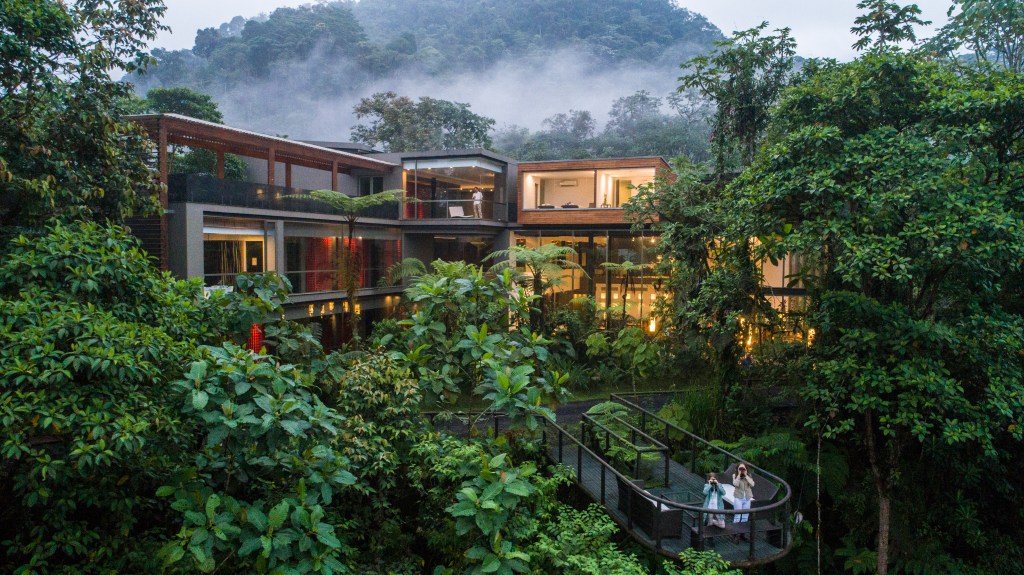
Built in 2012, Mashpi Lodge, in Ecuador’s Chocó cloud forest, was conceived by former Quito mayor Roque Sevilla in 2001, when he purchased the property to protect 1,730 acres of threatened forest from logging.
For years, he used the area as a place to camp with his children, but a side interest in tourism (and a nighttime “bathroom” encounter with a very large snake) resulted in a project that became one of the most decorated eco-lodges in the world — one that fully funds the on-site research that in a few short years has helped identify 25 brand-new species unique to Mashpi.

Its staggering biodiversity is a magnet for international scientists of all stripes, and so the intimate resort, with 22 rooms and three suites, was envisioned as both a living laboratory (an actual working space that guests can visit) and something I’d call an ambassador factory.
You cannot visit this place, which offers the highest-end sustainable tourism experience imaginable, without going home a zealot, primed to proselytize about the importance of protecting such places.

“There was another manager who used to say that people should arrive as tourists but leave as naturalists. It sounds nice in Spanish — como turista, vete como naturalista — but yours is actually better,” chuckles Alex Veintimilla, hotel manager at Mashpi Lodge.
I don’t know about that.
I only know that there have been dozens of assignments standing in the way of this pulpit. Now that I’m here, I’m ready to testify.

Since 2012, Mashpi has hosted thousands of guests and has expanded from its original 1,730 acres to more than 7,400. Lush trails, some quite challenging, wind up and down through the forest, from waterfalls to outcroppings to observation towers and contraptions, including The Sky Bike and something they call “The Dragonfly.”
More on these later.

Built into the mountainsides, thousands of Coca-Cola crates serve as durable pavers helping hikers navigate the wet terrain and lush foliage that, in some places, closes in on either side. The scope of this project, I think, as my boots move from one to the next, miles in just two or so days of exploration, is astronomical. When replacement time comes, it will be another massive undertaking.
The three-hour drive from Quito to Mashpi is mostly smooth, growing excessively bumpier as you get closer. This is the cloud forest, yes, but its elevation is actually lower, so those whose adjustment in the city was sketchy tend to find relief. The cost of it, however, is boots and bug repellent.
Have some seriously smoky fun on a Gulf Coast fish-dip crawl
A pittance, for when you enter the lodge, you are handed a cooling beverage and gaze out the back wall of glass.
The vastness, the green, the clouds, the wild.
I blinked back tears and sipped hibiscus tea.
I went outside and stood on the observation deck, which stretches out over a dropoff to the forest floor. I saw a spider wrapping a meal on an orchid. Savage nature.
My lunch, post-orientation, was served inside. Vibrant sauces and edible flowers on stoneware. The dichotomy of the Mashpi experience.

Guest rooms here, like the central hub of the property, have floor-to-ceiling glass walls. The forest comes right to the pane.
In my first five minutes after settling in, standing rapt at my window, I checked several birds off the guide I was given upon check-in: the golden olive woodpecker, the bay wren, the palm tanager.

It is total cloud forest immersion — tree frogs to tarantulas to those aforementioned tayras and expert guides to lead you — but with a spa, a bar and an all-inclusive, top-shelf dining program when you’re ready to pry off the wellies and shower up.
After the welcome and the meal, our group gathers outside to fit ourselves for the heavy rubber boots we’ll need to explore the terrain. It’s here that we meet our naturalist guide, Anderson Fernando Medina Armijos (Anderson Medina in its simplest form), whom we call Fernando.

“There is already another Anderson here,” he explains, laughing.
Medina, like many who work here, comes from a village not far away. His is Pachijal, where his father worked the land as a farmer and where he was on track for a similar path when a severe hand injury involving a machete — he shows us the scar — knocked him happily off course.

He joined the team here in his teens, working with the researchers as often as possible and starting out with a lower-level job in the butterfly conservatory.
“He comes from humble origins,” Veintimilla tells me. “He taught himself English, he learned all the species, he’s earned several certificates related to biology, he became a guide.”

He became more, in fact, than that.
In 2018, Medina became a co-author in the description of the Mashpi glass frog, an achievement any young biologist could scarcely hope for. And a species I could scarcely hope we might find on our first night walk, but we did, and heard the story of an even younger Medina climbing 11 feet into a tree to get a glimpse of a tiny frog, nearly impossible to spot in a place such as this, and noticing minuscule differences between this and another, similar amphibian.
“I am living my dream here,” he says of the Mashpi life, which requires workers to stay in the on-site dormitory for shifts: 14 days on, seven off. Rinse, repeat. They play futbol on a cement slab in between shifts. We walk through a game. It is fun to see our servers and attendants in civilian clothes, relaxing.

“This is the only flat place in all of Mashpi,” Medina jokes, kicking the ball back in play.
Science is only one of the pillars of Mashpi. Another is hospitality.
My Sky Bike experience, nearly thwarted by a combination of my companion’s fear of heights (the bike dangles from a cable that rocks precariously above the forest floor as riders pedal) and my vertically challenged stature (even at the closest seat setting, I could not effectively pedal), Medina hopped on and with help from another pedaler at the platform, powered us across the divide and back.

On hikes, he’d mimic bird calls flawlessly and pull up sightings on binoculars and through telescopes. While others in our pack hung back, discussing everything from real estate prices to the effects of social media on teenagers (Really? We’re in the cloud forest, people.), I followed Medina like a puppy, navigating terrain that demands watching one’s step, waiting for him to stop, look and listen.

At the butterfly conservatory, he darted out to the deck, and I followed.
“Did you hear that?” he said, excitement palpable.
“No,” I laughed.
He grabbed his binoculars, pointing off into the trees. Faintly, I heard a squeak. A cabinet in need of WD-40.
“That’s a toucan,” he said.
By now, the rest of the group had followed. Medina was setting up a telescope.

Two or three chirps later, there it was in the circle of the lens. A real, live Chocó toucan. It was at least a quarter-mile away. Perhaps more. The farmboy from Pachijal is now the Beastmaster.
“There are very limited futures for the local young people around this region,” Veintimilla explains, “so right from the start, a key for the Mashpi project was to integrate as many people as possible from the local communities. It was challenging because most did not have any of the skills required to work in a high-level hospitality environment, but they’ve been trained, they take courses.”

Some, like our bartender or our server, Darwin (there are many, many Darwins in Ecuador, I learned; stay tuned for my Galapagos adventure), come from Quito or elsewhere.
Others, like Nestor, now the Expedition Leader, are from the forest itself.
“He’s a wonderful example,” Veintimilla says,” a local guy who literally walked up one day looking for work.”

To watch him greet new guests upon arrival, to discuss the day’s outings as groups coordinate, coming and going, you would think he had a luxury hotel pedigree. Which, eight years into his Mashpi Lodge tenure, I suppose, is exactly what he has.
As I hover in The Dragonfly (which my companion, despite his acrophobia, has settled into), Medina discusses binoculars with a guest from Connecticut, and the difficulty of getting good equipment to this remote location.

I lean over and see before me the terrain I’d hiked that morning: the winding trail, the 114-foot Magnolia Waterfall where some in my group (the ones not from Florida) chose to take an icy plunge, the riverbed we’d walked, deep enough to fill a boot in places if you’re not careful, the rocky place where a green-fronted lancebilled hovered, defending his territory from others that might exploit his hunting ground.
As we approached some trees high enough to hit eye level, Medina found his treasure for the day, one that might make it onto the blackboard where guides announced their best sightings — equal parts boast and breadcrumb for colleagues to follow with their own groups.
“That’s an umbrellabird,” he tells us, pointing out a large black bird with a dashing, hat-like crest and black, feathery wattle. “This is so rare, you guys!” he whisper-shouts.
“It’s so rare!”
His delight, so genuine, is now mine.
Forever.
Find me on Facebook, TikTok, Twitter or Instagram @amydroo or on the OSFoodie Instagram account @orlando.foodie. Email: amthompson@orlandosentinel.com, For more foodie fun, join the Let’s Eat, Orlando Facebook group.
