


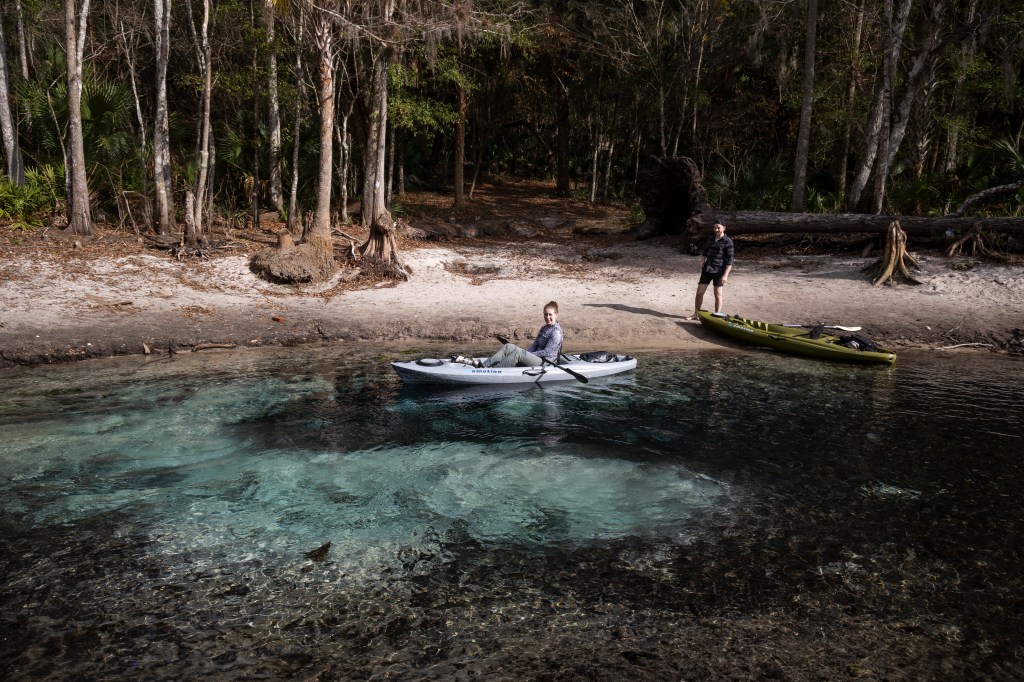
Florida is unparalleled in its concentration of pristine, shimmering, azure-blue freshwater springs, tallying more than 1,000 such examples throughout the state.
These natural gems give a glimpse into the Floridan aquifer, a system of porous limestone that forms underground caves and rivers, pushing water up through vents and ultimately flowing into the faucets of millions of Sunshine State residents.
These springs were the same sources of awe, wonder and intrigue that sustained Native Americans, animals and ecosystems alike for centuries before modern-day humans got their hands on the state’s treasured resources and soiled them, like the 20 lost springs of the Ocklawaha River.
These pristine gems of wild Florida are typically covered up and drowned out under 8 feet of brown, stagnant water held back by the Kirkpatrick Dam, which creates the Rodman Reservoir in Putnam County. Built in 1968, what was formerly called the Rodman Dam was created and left as the most detrimental legacy of the ill-fated and incomplete Cross Florida Barge Canal.
Lawmakers are currently debating the future of the dam, which is already several years past its intended lifespan and continues to cost taxpayers millions of dollars in maintenance. As legislators meet, a scheduled dam drawdown offers a glimpse of the river’s natural flow and reveals the blue-hued treasure of the lost springs.
Ocklawaha River bill looks to restore waterway, leaves dam removal to panel
Drawdowns occur every 3-4 years, returning the river closer to its historic water level to “maintain the health” of the reservoir and flush out accumulated vegetation and sediment. This scheduled maintenance is only required because the Rodman pool is a man-made ecosystem, not natural, but the event still provides recreational benefits for paddlers.
During each drawdown, those 20 lost springs near the Ocala National Forest are suddenly revealed again, inviting visitors to swim while offering a glimpse of what a restored, free-flowing Ocklawaha River could look like.

Patrick Connolly/Orlando Sentinel
Historical photos showing the building process behind the scrapped Cross Florida Barge Canal project can be seen on a short hike at The Island, an interpretive historical park in Ocala. (Patrick Connolly/Orlando Sentinel)
A brief history lesson
Over the last several centuries, explorers, traders, politicians and business owners have floated the idea of making the Sunshine State crossable by combining inland waterways. Despite surveys in the 1800s indicating that building a canal would be too costly or difficult, construction began in the 1930s under President Franklin Roosevelt’s New Deal.
“This is something that people have been looking for and pushing for since territorial days,” said Steve Noll, a University of Florida professor who co-wrote “Ditch of Dreams: The Cross Florida Barge Canal and the Struggle for Florida’s Future.”
“There was no real push to do it until the Depression, and then it became a jobs issue,” he said.
While the project employed 6,000 workers, funding ran out within three years as local critics began raising concerns about the disruption to Florida’s aquifer and waterways.

The project was revived in 1964 by President Lyndon Johnson but faced strong opposition from environmentalists, including Marjorie Harris Carr, the barge canal’s most vocal critic.
In 1969, she founded Florida Defenders of the Environment, filed a lawsuit and generated widespread resistance to the canal.
“The project could endanger the unique wildlife of the area and destroy this region of unusual and unique natural beauty,” wrote President Nixon in a statement dated Jan. 19, 1971. “The step I have taken today will prevent a past mistake from causing permanent damage.”
Even though the project was halted by Nixon, Florida lost countless oak trees, long-leaf pines and many wild animals. Thousands of people were also displaced by the government’s land acquisition. The legacy of “Florida’s folly” continues to this day.
“From 1971 to 2026, we’ve been fighting over what to do with this,” Noll said of the ongoing battle about the dam’s future.

Uncovering lost springs
“Cannon Spring,” “Blue Spring” and “Bright Angel Spring” are all names of natural springs that have been lost under the brown waters created by the Rodman Reservoir.
All 20 of these “crystal pools” were explored and documented in 1971 by Elizabeth Abbott, a geology doctoral student at the University of Florida. The largest of these, in terms of flow and surface area, was Marion Blue Spring, which was once popular for swimming, fishing, picnicking, and camping.
“The most discriminating of seasoned fisherman marveled at the ‘quality’ of fish at Blue Spring, not to mention the ‘quantity,’” reads Abbott’s report.
While Blue Spring still isn’t quite visible during a drawdown, others are. Cannon Springs is perhaps the most prime example of this. During a paddle in late December, two friends and I followed a shallow spring run back into the woods, amazed to find a blue pool of bubbling water.
We eagerly jumped in and snorkeled, marveling at the untouched nature of this pristine gem. After seeing such a spring in its blue-hued glory, it’s hard to imagine the natural wonder under brown, murky water when the water levels come back up in April.
Even after the water levels are brought up, it’s possible to explore these springs through the “Lost Springs” documentary produced during the last drawdown by Florida filmmaker Matt Keane.

Scars of the past
When the Rodman Reservoir was created in the late 1960s, the impoundment of water flooded more than 7,500 acres of forested wetlands.
The scars of the past become painfully visible during a dam drawdown, exposing a graveyard of cypress trees that didn’t survive the inundation of water. Veteran kayak guide Lars Andersen led a group of 15 paddlers and me on a tour of the site in early February.
It feels like a gut punch seeing that visual remnant of the human-caused destruction that resulted from the canal’s construction.

“You see all those trees, and it’s surreal. You say, ‘God, this is what we did. This is awful,’” Noll said. “The visibility of what happened there is much more open now. I think more people are seeing this and saying, ‘Oh my god, let’s undo what we did.’”
It’s even more gut-wrenching when considering the massive 306-ton crawler-crusher that was used to mow down cypress swamps in building this project.
During a stop on our paddle, checking out a muddy riverbank that was exposed by the drawdown, Andersen pointed out a sapling of hope. A miniature cypress tree sprouted from the muck.

“The cypress swamp will recover very rapidly once the water levels are brought back down to historic levels and the dam is breached,” said Bob Knight, the longtime leader of the Florida Springs Institute, noting the benefit to fish and manatee movement, plus an influx of freshwater flowing to the St. Johns River downstream. “Breaching the dam so that the river runs freely would be incredible. It’d be the best thing that’s happened in Florida since the protection of the Everglades.”
Hope for the future
As legislators consider the future of the Rodman Reservoir and the Ocklawaha River, environmental advocates from the Great Florida Riverway Trust, St. Johns Riverkeeper, Florida Defenders of the Environment and many more have renewed hope.
“As an environmentalist, I’m extraordinarily optimistic that this is going to happen. As a historian, I think that it’s probably not,” Noll said. “I think it might have to wait until after DeSantis leaves office.”

In 2024 and 2025, Gov. Ron DeSantis vetoed funding in the state budget for restoring the river.
“Every so often, we get a hopeful moment,” Andersen said. “We’ve learned over the years not to get our hopes up.”
Hope isn’t always much to hang your hat on, but the dream lives on that one day the Ocklawaha can be restored to its former glory, just like the Kissimmee River or the Everglades. Maybe it’s possible to find a way to turn back time and bring back a piece of wild Florida that has spent nearly six decades drowned in the ditch of dreams.

Exploring the river
When attempting an outing before water levels come back up again, Cannon Spring and Tobacco Patch Spring can be accessed by putting in at Paynes Landing (Cypress Bayou Boat Ramp) in Fort McCoy and paddling upstream, then floating back down. Alternatively, enter the river using the Eureka East or Eureka West boat ramps and paddle one-way down to Paynes Landing.
To see the cypress graveyard, put in at 191 Kenwood Boat Ramp Road in Interlachen for an out-and-back paddle of 2-3 miles.
Contact Lars Andersen at 386-497-4214, riverguide2000@yahoo.com or by visiting adventureoutpost.net to learn more about Ocklawaha trip availability.
Find me @PConnPie on Instagram or send me an email: pconnolly@orlandosentinel.com. Stay up to date with our latest travel, arts and events coverage by subscribing to our newsletters at orlandosentinel.com/newsletters.
